

Gallery Blog
"Clarity of Color" Featuring the Work of Marla Bagetta
Art Elements Gallery is excited to announce the opening of our latest show "Clarity of Color" which will feature the painting and pastel work of Oregon artist Marla Bagetta.

Marla Bagetta, "A Simple Surrender"
"Clarity of Color" opens June 23rd and will run through August 20th with an artist's reception June 23rd from 5-7
Marla Baggetta's approach to painting reflects the formal art education she received at Art Center College of Design and her experience as a landscape painter. A self-employed, professional artist since 1983, Marla had a distinguished career as a commercial illustrator before turning to landscape painting, working for clients such as Walt Disney, Nissan Motors, Houghton Mifflin Publishing, to name just a few. After moving to Oregon in 1993, she began painting the landscape and quickly established herself as one of the West's leading representational painters with her compelling and sophisticated imagery. She is a signature member of the Pastel Society of America and the Pastel Society of Oregon. Marla has won numerous awards for her paintings and has been featured in the premiere publication for pastel painters, Pastel Journal. Marla is also the author of Step by Step Pastel published by Walter Foster Publishing.
Marla say's of her work that...
I am a great believer in the fundamentals of painting; drawing, composition, color theory and the thought that paintings communicate an idea through this vocabulary. The process of bringing a concept to a complete image is deeply compelling and satisfying. My painting process is a very active one where my first marks and impressions are usually bold and gestural. Then I settle in and make assessments and refinements. The last marks are usually slow, quiet ones, as I am making small moves to find my way towards the finished piece. I'm hoping to capture the "aha!" that originally attracted me to my subject. Each one of my original pastels is done on museum grade sanded pastel paper. I use a variety of brands of soft pastel, each with different characteristics that I use to accomplish a variety of strokes and washes within a piece.

Marla working in her studio
We are thrilled to share this new body of work with you, and hope you will stop by the gallery this summer to see it in person!

A Technique of the Modern Age: The History of Plein Air Painting

Gustave Courbet, Bonjour Monsieur Courbet” (1854) Gustav Courbet depicts himself with all his painting gear in his pack, greeting friends on his way to paint out of doors. This is the most iconic representation of plein air painting.
The practice of painting en plein air (a french phrase that translates loosely to painting in “full” or “open” air) is a favorite pursuit of many of our landscape painters here at Art Elements. As this is a phrase we hear often around the gallery, I thought it might be fun to dig a little bit into the history of this particular painting tradition to learn a little more about it, and to see what gets our artists like Don Bishop, Romona Youngquist Mandy Main, Michael Orwick, and Molly Reeves so excited.

Art Elements artist Don Bishop, paints a lavender field en plein air

Art Elements Artist Romona Youngquist, Sunflower Farm, 6x8
As the phrase suggests, painting en plein air, essentially involves hauling one’s materials out to the remote location of your choice and painting directly from nature, rather than using a sketch, photograph or memory to reconstruct what was seen from within the confines of a studio. This was a favorite practice of French impressionist, like Claude Monet, Pierre- Aguste Renoir and Paul Cézanne.

John Singer Sargent, Claude Monet Painting by the Edge of a Wood (1885) now located at the Tate Gallery in London
For me, the notion of plein air painting conjures romantic images of the solitary and meditative artist at work in an entirely natural environment. There is something deeply organic and pure about this notion, as if this might be the way that painting originated.
Plein air painting is in fact, just the opposite, a modern invention, and one that is directly tied to the technological developments of the industrial era. Plein air painting might never have taken off had it not been for a simple modern invention.
In 1841 a man by the name of John Goffe Rand invented something simple, and revolutionary, the collapsible zinc paint tube with a stopper cap.

John Goffe’s patent drawings
Prior to this, paints were mixed in the studio by the individual artist, and once they were mixed they had to be carried in glass jars if they were to be transported anywhere. Considering the vast amount of colors and pigments that an oil painter might use to complete one work, the idea of packing up all of those glass jars and trekking out with them, sometimes many miles, to capture a desired scene, was basically impossible. But thanks to Mr. Goffes’s invention, artists were suddenly much more mobile! What’s more, paint could be mass produced and purchased by artists ready to use in the tube. I can’t help but this as the 19th century painters version of the i-phone, suddenly it’s a whole new world thanks to one little invention. Goffe’s pre-packaged paint tubes dramatically changed his customer’s relationship to their world and how they could depict it in their art.
Even thought when we think if plein air painting we often thing of the French impressionists, who popularized the practice, it actually began a generation earlier with the Romantics. English landscape artists John Constable and J.M.W. Turner were actually were actually some of the first artists to make names for themselves painting in this style. technique. Like our own Romona Youngquist, Constable loved to depicted pastoral imagery, often painting farm houses, barns or workers in their fields.

John Constable, The Haywain, 1821, now in the collection of the national gallery London. Constable predated the impressionists and was of the generation of Romnatic painters.
The barbazon school and the American Hudson River school of painters also took advantage of this opportunity prior to the impressionist co-opting of the practice.
So in fact, while we might tend to think of plein air painting as a return to nature, it would not have actually been possible if it were not for the technological advancements of the 19th century. And in fact, what these painters started a tradition of depicting not, unspoiled nature, but instead images of agriculture and industry, that our very on landscape painters continue to draw from today.
Our painters here at art elements, like their barbazon and impressionist forebearers enjoy the experience of plein air painting in a group. Romona, Don and Michael Orwick occasionally paint en plein air together (that is one afternoon picnic that I would love to be invited to).
These artists are surrounded by some of the most stunning natural and agricultural scenery in the country, thanks to the environment that has allowed our wine industry to flourish in this area as well. Romona describes a desire to “capture what she sees” and to share it. I think we can all connect with that feeling, of driving down a beautiful country road and seeing an expanse of landscape, a sunrise, a sunset, a passing storm that is so gorgeous you wish there was a way to capture its beauty and take it with you. By making the journey directly into nature with their canvas and paints, our beloved plein air painters are tapping into both an innate human desire to pursue beauty, and a tradition in western art that is rooted in one of the greatest artistic movements to date.

A Sticky Question: So What the Heck IS Encaustic Anyway?
So What the Heck Is Encaustic Anyway?
Encaustic – if you have spent much time around than you have probably heard of it. You might even know a little bit about it, but if you’re like me, the specifics of this particular medium are still somewhat mysterious.
Well – although I was a little familiar with encaustic already, after diving into the depths of the internet to learn more about this illusive medium, I have emerged with an even greater respect for our artists who chose to work in encaustic.

Borderline, by Art Elements Encaustic Painter Pam Nichols, 20x16
Encaustic, as you may already know, involves working with wax, more specifically bee’s wax. It requires that you heat up the wax and careful spread thing layers across you a wood surface. It’s a very labor intensive, intense and physical way to work.
The wax must be applied in thin, carefully monitored layers in order for the finished work to be visible.
The encaustic artist then either layers collage elements between the layers of wax, or can work pigments, with colored wax or mixed oil paint into the wax itself.
The result is pretty amazing. Encaustic artists are able to create two-dimensional works with an incredible sense of depth. It has been described as a spontaneous method, in the sense that once the wax hardens you can’t go back and make changes. You have one shot, then you’re done. You only have one opportunity to work with the material. This doesn’t lend itself to a lot of detail planning or rework, so often times, encaustic works have an expressive and yes, spontaneous feel to them. The other neat thing about encaustic is that once the wax has been applied to the surface of the work, its surface can be textured and worked over for a variety of different effects.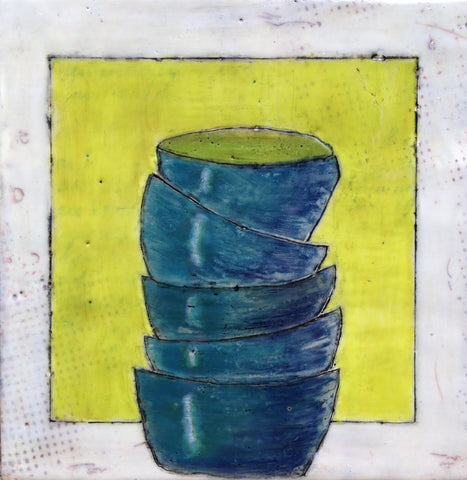
Stacked Up, by Art Elements Encaustic Painter Virginia Parks, 10x10 and on view at Pulp and Circumstance
One of the most famous artists to work with encaustic was the American Pop artist Jasper Johns. Is American flags (one of which is on view at MOMA) were made by using many thickly spread layers of encaustic bees wax. The result is almost impossible to capture in a photograph, but the affect in person is almost overwhelming.
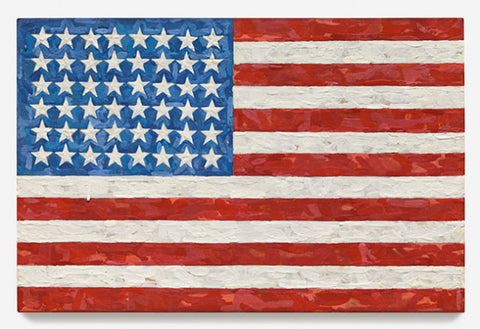
Flag, Jasper Johns, 1954 3' 6" x 5' 1", encaustic
However, far from a modern method, encaustic was originally used as long ago as the first century BCE! Greek warriors, who covered their ships with melted wax to seal them and make them water tight, found that by working pigments into the wax they could cover their ships in threatening war paint.
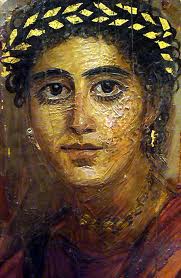
One of the Fayum Funerary Portraits, from 1st Century AD Greece. Perhaps one of the most famous examples of ancient encaustic painting
Encaustic is also extremely durable the wax essentially protects any paint or decoration beneath in a thick shield, so it was a favored method in the early Renaissance.
Here at art elements we have several artists who love to work with encaustic including Pam Nichols, Virginia Parks and others. We have to admit we are a little bit although it might seem a bit opaque at first, in love with this medium.

Warrior, Pam Nichols, 8x8